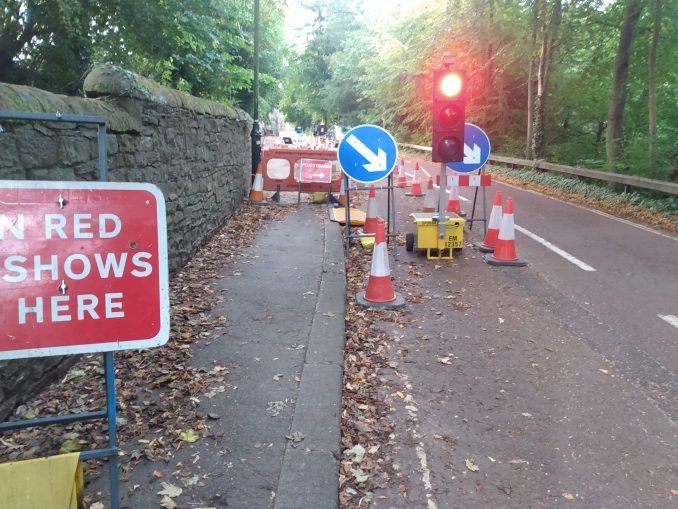
For a few weeks in August and September there was a trial of a new traffic arrangement on Quarryheads Lane, alongside the Durham School field. Temporary traffic lights were installed over a short section of road, so that vehicular traffic had to alternate directions. Part of the carriageway was coned off to devote it to pedestrian use.
Overall, the experiment seemed to be very successful, and SPACE for Durham hopes that something permanent will be introduced soon. The lights had the effect of reducing the speed of the motor traffic, and cutting the dangerous overtaking that people cycling along this section often experience. Cars generally drive too fast over this part of road. The sights we are now seeing again, of inflated SUVs bombing past the crowds of pedestrians who spill off the pavements during the university term bring home just how urgent it is to improve this key walking and cycling route.
Of course, actually it was not an official road traffic experiment: the temporary lights were to enable work repairing the historic boundary wall which had been bulging for years. The temporary lights do not seem to have any noticeable impact on alternative routes that we have heard of. Instead of lights, perhaps some chicanes (with cycle bypass lanes), or a one-way arrangement for motor traffic, would be the best options? Or even a congestion charge to discourage the people who currently use it as a rat run.
Quarryheads Lane and Margery Lane have been identified as primary cycling and walking routes in the Durham City LCWIP (Local Cycling and Walking Infrastructure Plan). What proposals does Durham County Council have for improving this vital active travel route?
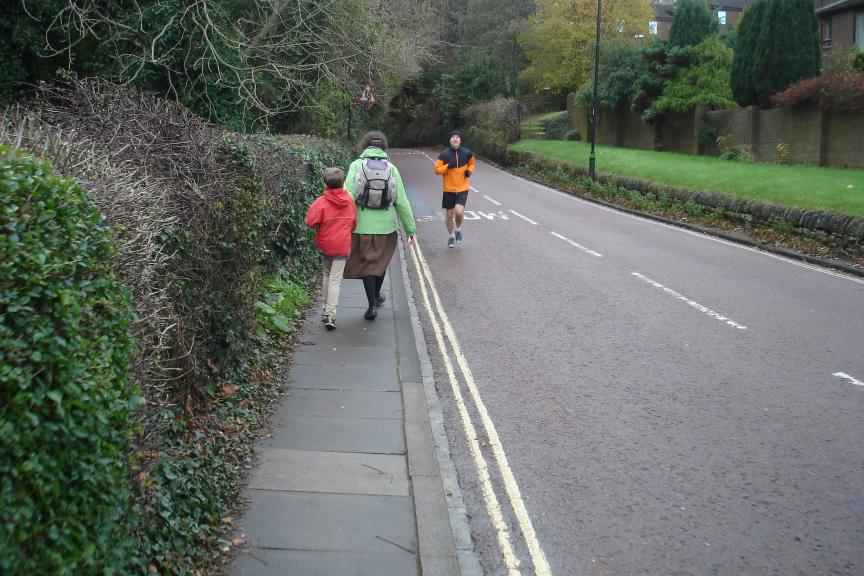
The recommended minimum footway width in UK national guidance is now 2m, and that applies to quiet roads: on a busy route the width may need to be greater. Currently the narrowest park of the footway, alongside Durham School buildings, is 80 cm, and many sections are well under 150 cm, the absolute minimum required for wheelchair users to pass each other. It is even more constrained when the vegetation is allowed to get out of control. It is not really possible for a parent to walk alongside a child, or for people to be sociable and walk comfortably side by side. It is high time that some of the carriageway was repurposed to provide wider pavements and a dedicated cycleway.
Leave a Reply