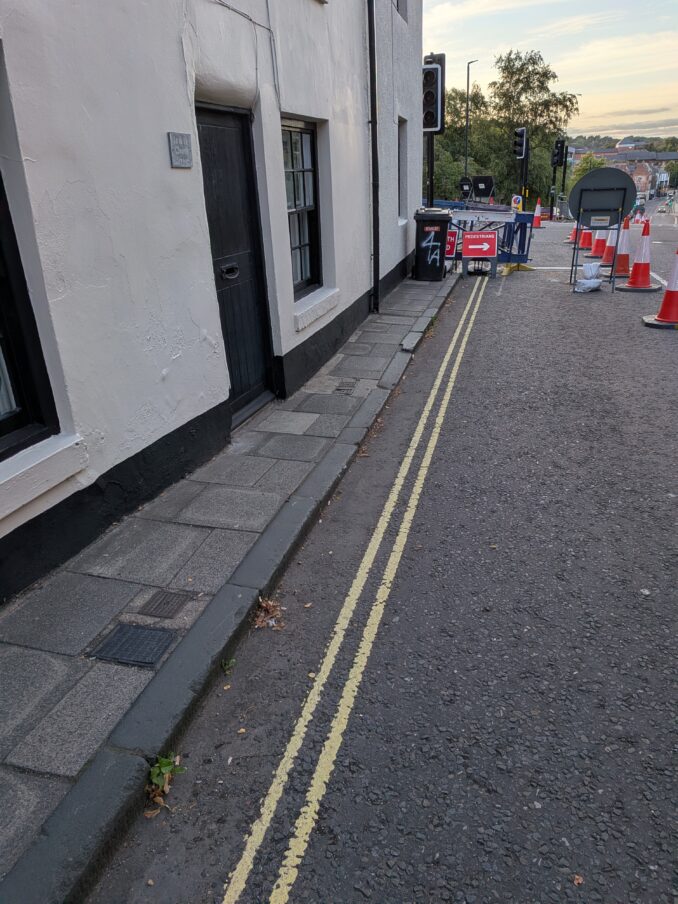
This month’s pavement has to be a strong contender for the narrowest pavement in Durham. The width is about 70cm, including the kerb. The Department for Transport’s guide Inclusive mobility: A Guide to Best Practice on Access to Pedestrian and Transport Infrastructure (December 2021) states in section 4.2:
Footways and footpaths should be made as wide as is practicable, but under normal circumstances, a width of 2000mm is the minimum that should be provided, as this allows enough space for two wheelchair users to pass, even if they are using larger electric mobility scooters. If this is not feasible due to physical constraints, then a minimum width of 1500mm could be regarded as the minimum acceptable under most circumstances, as this should enable a wheelchair user and a walker to pass each other. Where there is an obstacle, such as lamp columns, sign posts or electric vehicle charging points, the absolute minimum width should be 1000mm, but the maximum length of such a restricted space should be 6 metres.
This pavement is therefore narrower even than the absolute minimum acceptable width, and is probably unusable in even the narrowest wheelchair. It feels quite precarious even just walking along it. The width may be even less than 70cm where the drainpipe comes down the side of the house.
The photograph was taken while work was taking place on Church Street to relay pavements there. Handily this entailed laying cones to make Hallgarth Street one way to traffic, so if you want to walk on the west side of Hallgarth Street in safety, now is your best chance!
Leave a Reply